700th anniversary of the introduction of gold coinage – the florin – in the Kingdom of Hungary
€100 gold collector coin
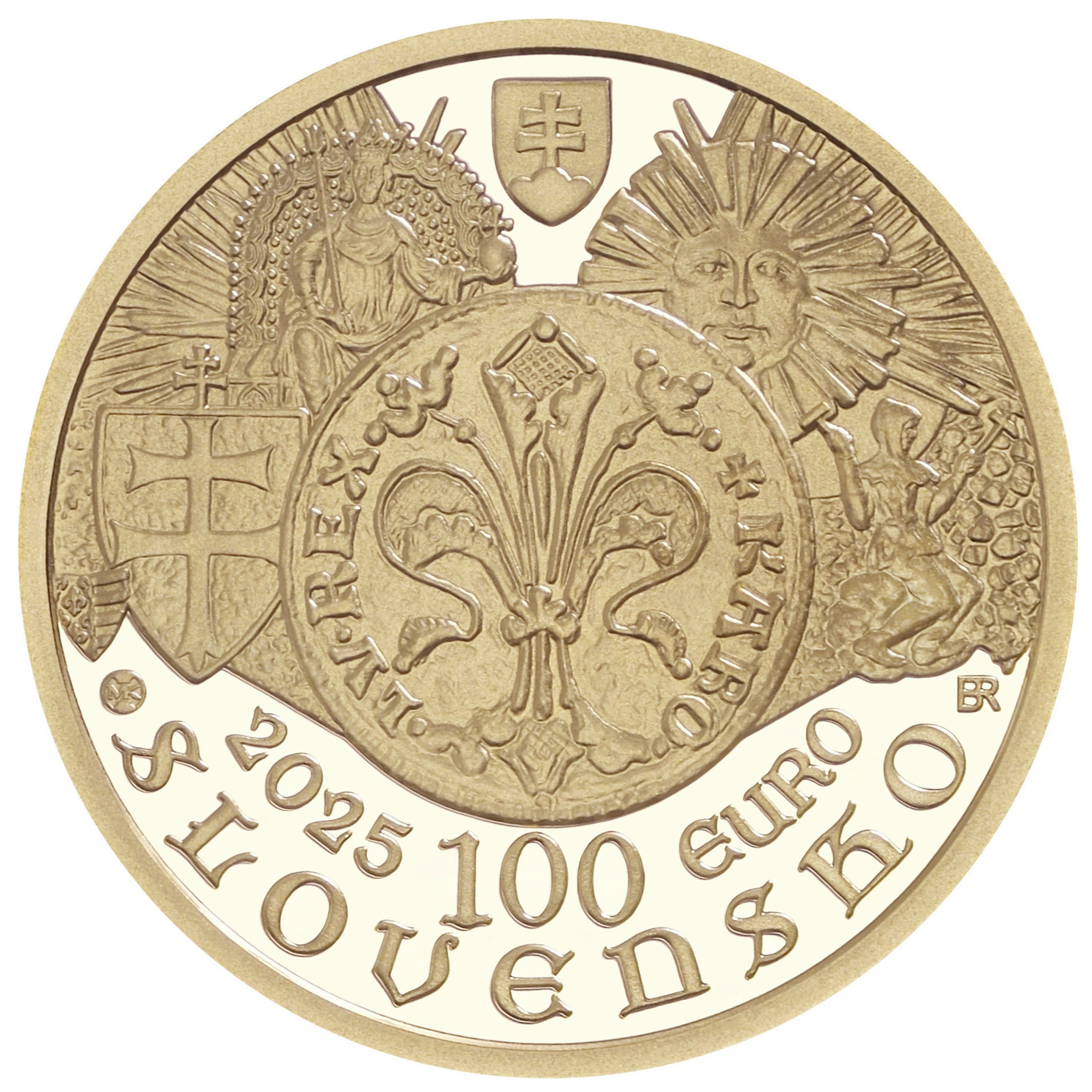
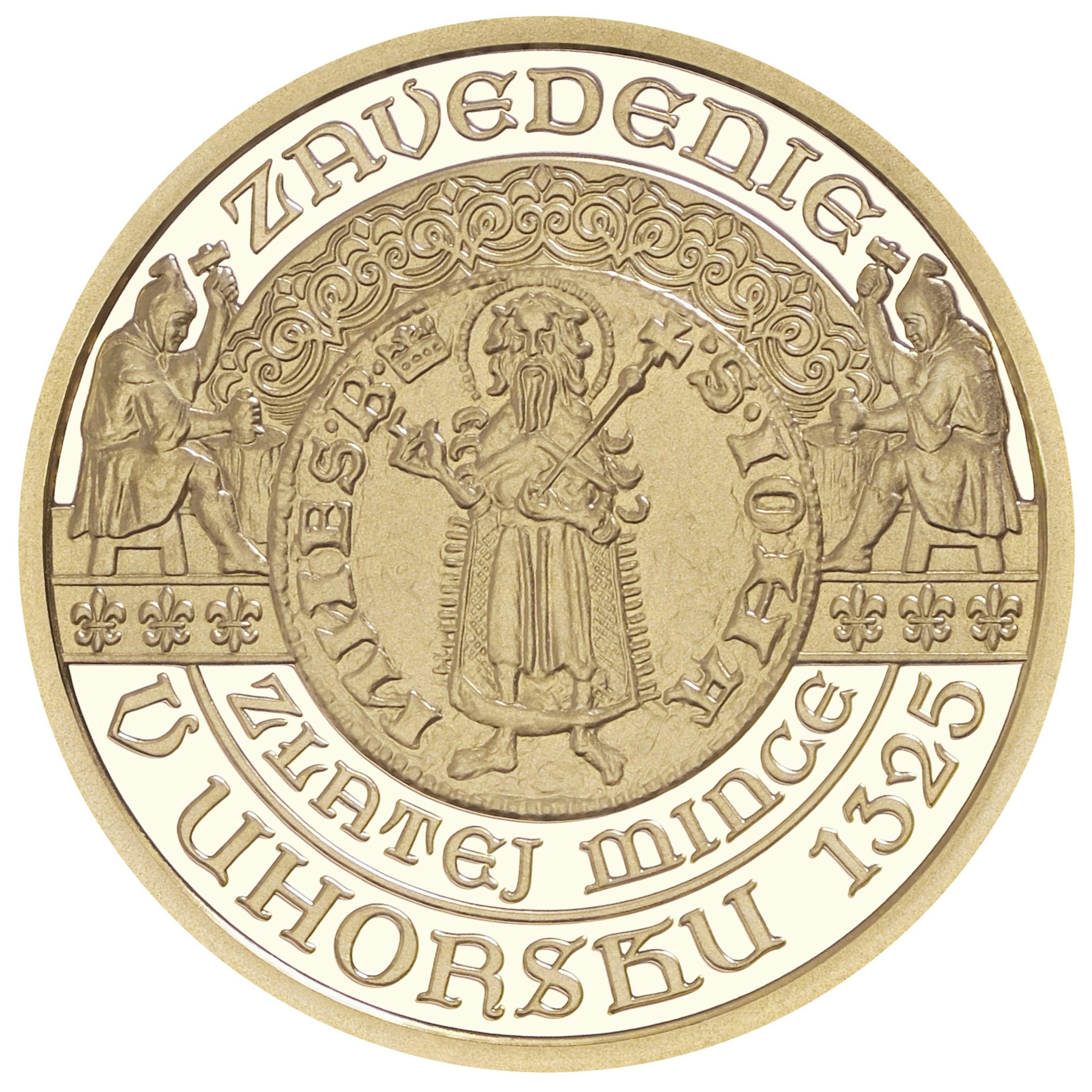
The minting of gold coins in the historical Kingdom of Hungary (encompassing present-day Slovakia) began with the introduction of the florin in 1325, during the reign of King Charles Robert. The Hungarian florin was patterned after the Florentine florin (fiorino d’oro), which had been minted in Florence since 1252. The obverse featured the fleur-de-lis badge of Florence, while the reverse depicted Saint John the Baptist, the city’s patron saint, encircled by the Latin abbreviation of his name, ‘S IOHANNES B’. The only difference from the Florentine original was the inscription around the fleur-de-lis, which read ‘KAROLV REX’ (King Charles). The florin had a gold purity of 99% to 99.7% and weighed over 3.55 g, with a pure gold content of up to 3.52 g. The coins were minted at three locations: Buda, Kremnica, and Cluj (Transylvania). Since all the florins were struck without a mint mark, it is impossible to determine where a particular coin was produced. Owing to its high quality and Hungary’s extensive international trade, the florin was widely exported. It was minted throughout the reign of King Charles Robert and, after his death in 1342, for some time during the reign of his successor, King Louis the Great.
-
Coin description
Obverse:
The obverse depicts the historical Hungarian florin introduced by King Charles Robert, featuring the Florentine fleur-de-lis and the inscription ‘KAROLV REX’. To the left is a shield with a double cross, and between it and the left edge is the Hungarian Angevin coat of arms. Above is a depiction of the king on his throne. At the top is the Slovak coat of arms. To the right is an image of the sun, and below it a miner extracting ore. Along the bottom is the name of the issuing country ‘SLOVENSKO’, above which appear the year of issuance ‘2025’, the denomination ‘100’, and the currency ‘EURO’. On the left side, below the coat of arms, is the mint mark of the Kremnica Mint; on the right side, below the miner, are the stylised initials ‘BR’ of the coin’s designer, Branislav Ronai.Reverse:
The reverse features the reverse side of a florin from the reign of King Charles Robert, showing St John the Baptist and the encircling inscription ‘S IOHANNES B.’, ending with a crown. To each side is a minter at work. Between them, curving above the florin, is a decorative pattern of intertwined Anjou lilies, and beneath each minter is a band of Anjou lilies. The inscription ‘ZAVEDENIE ZLATEJ MINCE V UHORSKU 1325’ (‘Introduction of gold coinage in Hungary –1325’) appears with the first word along the upper edge and the remainder in two curved lines below the florin, separated by a line.
-
Coin details
Designer: Branislav Ronai Composition: .900 gold, .75 silver, .25 copper Weight: 9,5 g Diameter: 26 mm Edge: milled Producer: Kremnica Mint Engraver: Dalibor Schmidt Issuing volume: 4,600 coins in proof quality Issuing date: 25 November 2025