-
NBS Tasks
Browse topics
- Monetary policy
- Financial market supervision
- Financial stability
- Banknotes and coins
- Payments
- Statistics
- Research
- Legislation
-
Publications
- Activity Report of the NBS Innovation Hub Annual Report Carbon Footprint Report of NBS Climate-related disclosures of NBS non-monetary policy portfolios Economic and Monetary Developments Financial Stability Report Investment Policy Statement of the National Bank of Slovakia Macroprudential Commentary
- Policy Briefs Report on the Activities of the Financial Market Supervision Unit Research Papers: Working and Occasional Papers (WP/OP) Statistical Bulletin Structural Challenges Other publications Sign up for your email notifications about publications
- About the Bank
- Media
- Frequently asked questions
-
For the public
Browse topics
- About the Bank
- Exchange rates and interest rates
- Banknotes and coins
- Payments
- Financial stability
- Financial market supervision
- Statistics
- Legislation
-
Publications
- Activity Report of the NBS Innovation Hub Annual Report Economic and Monetary Developments Financial Stability Report Macroprudential Commentary
- Report on the Activities of the Financial Market Supervision Unit Research Papers: Working and Occasional Papers (WP/OP) Statistical Bulletin Other publications Sign up for your email notifications about publications
- Frequently asked questions
- Media
- Careers
- Contact
Monetary Policy and Climate Change
Climate change has a significant impact on monetary policy. Changes in atmospheric conditions, climate policies (both adopted and under consultation), and the transition to a low-carbon economy affect prices, economic activity, labour productivity, and other key macroeconomic indicators through multiple transmission channels. In line with their mandate, central banks take these factors into account in order to maintain price stability over the medium term.
Changes in atmospheric conditions affect food prices and, indirectly, energy prices, which are key components of inflation dynamics.
Rising temperatures and long-term shifts in weather patterns impact labour productivity and agricultural output. Extreme weather events can damage infrastructure, accelerate capital depreciation, disrupt supply chains, or create imbalances in labour markets, thereby weighing on economic activity and affecting growth across sectors.
The transition to a low-carbon economy also has important implications for monetary policy. Ongoing discussions on climate policy proposals, such as carbon pricing, may influence inflation expectations by affecting firms’ cost expectations and household price perceptions. The implementation of such measures can lead to significant changes in the price level. At the same time, more complex changes in investment structure or shifts in consumer behaviour could affect output, productivity, and, as a result of temporary imbalances, the price level as well.
Economic and Financial Impacts of Climate Change
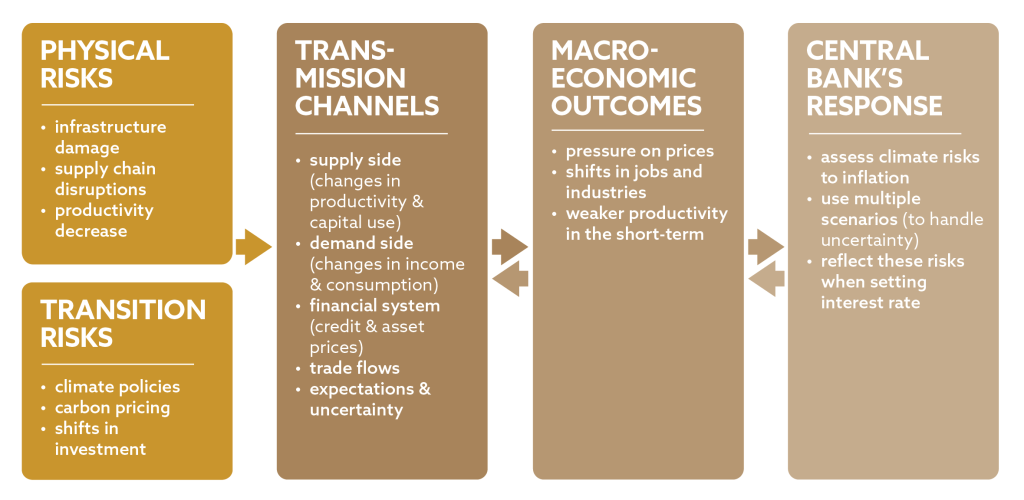
Against this background, central banks need to understand the complex interactions between physical and transition risks related to climate change and price stability. This requires incorporating climate-related considerations into macroeconomic analyses, forecasting and monetary policy decision-making in a systematic and forward-looking manner.
As Slovakia is a member of the euro area, monetary policy decisions are made jointly with other members at the level of the European Central Bank (ECB) within the Eurosystem. The National Bank of Slovakia (NBS) contributes to this joint-decision making by providing a Slovak-specific perspective reflecting the structural characteristics of the domestic economy. In addition, the NBS plays an important role in clarifying the links between climate risks and their economic, financial, and social consequences, and contributes to raising public awareness of these connections by sharing analytical insights and findings.