-
NBS Tasks
Browse topics
- Monetary policy
- Financial market supervision
- Financial stability
- Banknotes and coins
- Payments
- Statistics
- Research
- Legislation
-
Publications
- Activity Report of the NBS Innovation Hub Annual Report Carbon Footprint Report of NBS Climate-related disclosures of NBS non-monetary policy portfolios Economic and Monetary Developments Financial Stability Report Investment Policy Statement of the National Bank of Slovakia Macroprudential Commentary
- Policy Briefs Report on the Activities of the Financial Market Supervision Unit Research Papers: Working and Occasional Papers (WP/OP) Statistical Bulletin Structural Challenges Other publications Sign up for your email notifications about publications
- About the Bank
- Media
- Frequently asked questions
-
For the public
Browse topics
- About the Bank
- Exchange rates and interest rates
- Banknotes and coins
- Payments
- Financial stability
- Financial market supervision
- Statistics
- Legislation
-
Publications
- Activity Report of the NBS Innovation Hub Annual Report Economic and Monetary Developments Financial Stability Report Macroprudential Commentary
- Report on the Activities of the Financial Market Supervision Unit Research Papers: Working and Occasional Papers (WP/OP) Statistical Bulletin Other publications Sign up for your email notifications about publications
- Frequently asked questions
- Media
- Careers
- Contact
European regulatory framework
Before the Covered Bond Directive (CDB) entered into force, the EU’s legislative provisions on covered bonds consisted only of general requirements for the structural elements of covered bonds under Article 52(4) of the UCITS Directive (2009/65/EC), with these requirements concerning only the issuance of covered by credit institutions, dual protection of investors, and public supervision. The conditions for obtaining preferential capital treatment for covered bonds were supplemented by Article 129 of the Capital Requirements Regulation (575/2013).
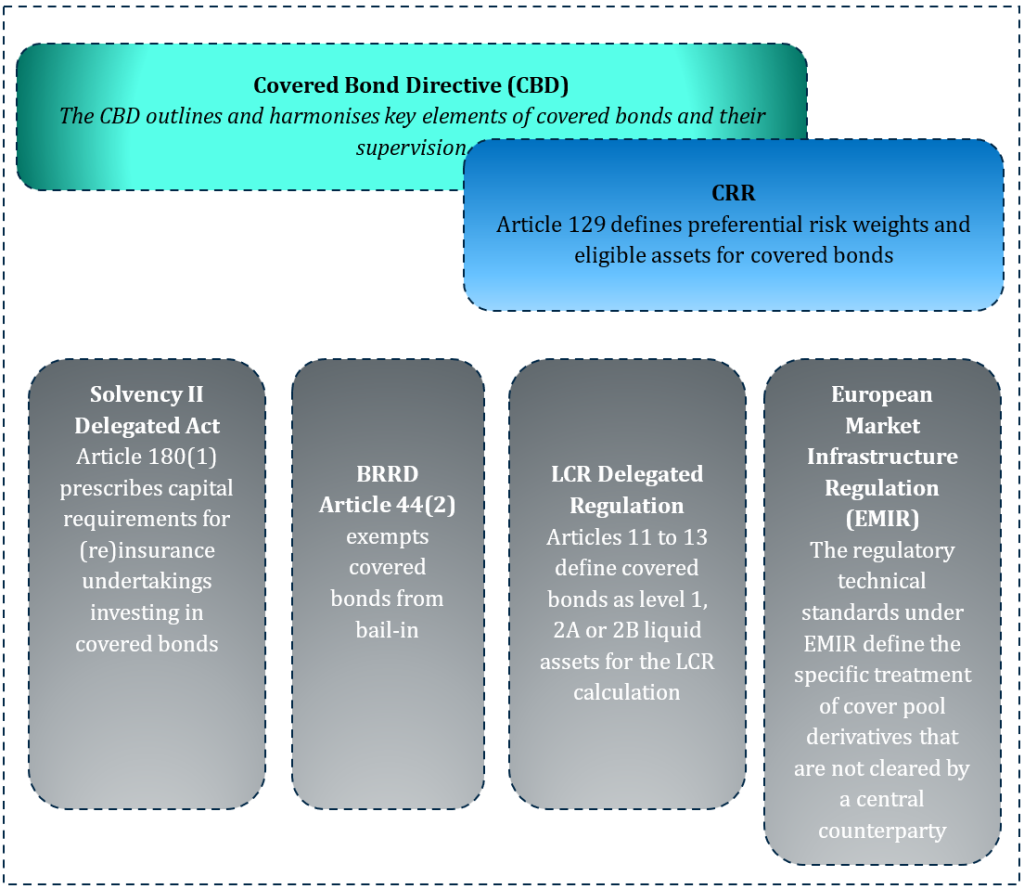
As the cornerstone of the new European regulatory framework for covered bonds, the Covered Bond Directive (CBD) specifies and harmonises not only conditions for the issuance of covered bonds on common principles, but also requirements for cover assets, transparency towards investors and the entire framework for the supervision of covered bonds. The legislative framework in this area also includes the following:
- the amended Article 129 of the Capital Requirements Regulation (CRR);
- Directive 2014/59/EU establishing a framework for the recovery and resolution of investment firms – known as the Bank Recovery and Resolution Directive (BRRD);
- Commission Delegated Regulation (EU) 2015/61 to supplement Regulation (EU) No 575/2013 of the European Parliament and the Council with regard to liquidity coverage requirement for Credit Institutions – known as the Liquidity Coverage Ratio (LCR) Delegated Regulation;
- Commission Delegated Regulation (EU) 2015/35 supplementing EU Directive 2009/138/EC of the European Parliament and of the Council on the taking-up and pursuit of the business of Insurance and Reinsurance (Solvency II);
- Commission Delegated Regulation (EU) 2020/447 supplementing Regulation (EU) No 648/2012 of the European Parliament and of the Council with regard to regulatory technical standards on the specification of criteria for establishing the arrangements to adequately mitigate counterparty credit risk associated with covered bonds and securitisations.